

SS Appam
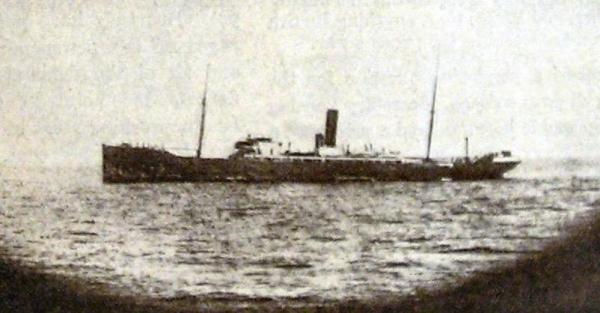
SMS Moewe

Lt. Hans Berg and Crew
SS Appam
German Sailors Interned
at Fort Oglethorpe
March 27, 1917 - October 6, 1917
Below is an article this author wrote for publication in the Chattanooga Regional History Journal (Winter 2024) about the first batch of German prisoners held at Fort Oglethorpe during World War 1 (1917). This is a great example of how the history of Fort Oglethorpe allows us to witness and understand national and international history.
The history of German prisoners at Fort Oglethorpe in World War 1 begins with a daring high seas adventure. In January 1916, near the Canary Islands, the German warship SMS Moewe came alongside the SS Appam, a British passenger steamer laden with passengers, cargo, and crew bound for Plymouth. A warning shot was fired across her bow, bringing her to a full stop. Without resistance, German sailors boarded and searched the vessel for contraband. Having seized what they wanted, they claimed the Appam a war prize and placed the command of the ship under the able seamanship of Lt. Hans Berg and a prize crew of 21 sailors. Fearing recapture if they tried to run the British naval blockade of Germany, Lt. Berg set course for the Hampton Roads, VA.
(Click on images to enlarge)

SMS Moewe (German for "Seagull")

SS Appam


The arrival of the Appam became a media sensation. Like dozens of other German vessels, they sought “intern” status in neutral America, but this put the US in a precarious position with Britian and France. The British owners of the Appam filed suit in the Virginia district court to get their ship and cargo back, with the court ruling in their favor. While Berg and his crew remained onboard, the Germans appealed the case to the US Supreme Court, who issued a landmark resolution that interning the vessel was clear violation of America’s neutrality.
By January 1917, Britian, France, Germany, and other nations had lost millions of men to the war, Germany had resumed its practice of unrestricted submarine warfare, and America was caught in a diplomatic gravitational pull that would drag her into the war. In the midst of these tremendous international tensions, British intelligence intercepted a secret communication from Germany urging Mexico to join them and attack our southern border. On March 3, 1917, in what became known as the “Zimmerman Telegram,” German State Secretary for Foreign Affairs Arthur Zimmermann publicly acknowledged that the cable was legitimate. It is noteworthy to mention that a year earlier, the famous 11th Cavalry Regiment was dispatched from Fort Oglethorpe (FTO) to guard the southern border.


On February 4, 1917, President Wilson severed relations with Germany. There were incidents of German intern crews sabotaging their ships to render them useless to the Americans. To prevent damage to the Appam, Berg and his prize crew were asked to leave the ship after living at anchor for more than a year. They did so without protest and the US government put them up in Norfolk hotels. Five days later, Berg and his crew were transferred to the Philadelphia Navy Yard where they joined about 700 other interned German sailors from the SS Kronprinz Wilhelm and the SS Eitel Friedrich.
The New York Times
By the time the sailors reached Philadelphia they had become national celebrities. A local tourist service advertised harbor excursions alongside the massive interned German ships. The sailors constructed a village in the shipyard they called Eitel Wilhelm in honor of both ships. The quaint village was a sensation among Philadelphians who came to purchase baked goods and craft items. One clergyman complained to the US Navy that one of the German ships was selling beer on Sundays. He was told the ships were considered German soil and recommended he appeal to the Germans directly. There were several escapes by the sailors, some being quickly captured, some not. In response to all this media attention and mayhem, the mayor of Philadelphia emphatically urged Washington to move the entire lot from his city.

Tourists visiting the "Eitel Wilhelm" German village at the Philadelphia Navy Yard, Photo credit Bill Edwards-Bodmer History is Now magazine


The first mention in a Chattanooga newspaper that the sailors were coming to FTO was on March 17, 1917. The Appam’s prize crew and the Friedrich’s crew were to be transferred to FTO, while the crew of the Wilhelm would be transferred to Fort McPherson (FTM), Atlanta. In that late winter, only about 200 troops were stationed at FTO, those of Troop A of the 2nd Cavalry Regiment, and two companies of general service troops and some new recruits, clearly not enough to guard 383 German sailors. To meet this need, the Army pulled the 17th Infantry Regiment from Mexico where they had been on the forefront of the hunt for the infamous Poncho Villa. Work began immediately to convert two of the barracks buildings in the northwest corner of what is now known as Barnhardt Circle into a stockade for the sailors. The buildings were encircled by inner and outer barbed-wire fences that were intended to carry electricity, although the fences were never energized.
The German sailors arrived at FTO on March 28, 1917. Their train of 14 coaches traveled overnight from Philadelphia to Chattanooga, taking the Central of Georgia line south out of the city to the quartermaster terminal on the post. A substantial crowd of Chattanoogans had gathered at the post to see the spectacular sight. Major Walton, the ranking commander on post at the time, issued orders restricting “kodak snapshots” no closer than 150’, and said, “I don’t want moving picture machines facing those men. They are not criminals. They do not deserve useless embarrassment.”

Above: Loading sailors' belongings at the Philadelphia Navy Yard
Below: Kronprinz Wilhelm sailors watching their Friedrich/Appam comrades depart the train at Fort Oglethorpe. Note the differences between these two pictures.
Photos courtesy of National Archives


The Chattanooga News
Guards lined the post roads with loaded rifles and fixed bayonets that flashed in the morning sun. The sailors were escorted through the cavalry stable streets to the barracks buildings where they were shown their new quarters. The rest of the afternoon was spent transferring their luggage in which the onlookers took great interest. Items observed were dozens of pets, including parrots, dogs, and game fowls, violins, large tea kettles, a plethora of personal baggage, and strange kitchen utensils.
On April 6, 1917, the US declared war on Germany. Over the next six months, FTO experienced an enormous amount of activity as the Army rapidly swelled their ranks for war. Berg and his men watched through the barbed wire as our troops trained on the Barnhardt Circle parade grounds. Ultimately, about 30,000 men trained at FTO for WW1.
In addition to the foreign war, America began fighting a domestic war against sabotage, espionage, and other unpatriotic acts. To accommodate these growing civilian arrests, Washington designated FTO as the war prison barracks for the eastern US (in the west it was Fort Douglas, UT). The sailors were tasked with building a new prison stockade to the northeast of the post. Berg insisted that he and the officers would not participate in the construction work. Over the next couple of months, the sailors completed the stockade and first few barracks. Washington then decided to separate the military prisoners from the civilian prisoners. On October 6, 1917, under heavy guard, the Germans sailors departed by train for FTM.

Moving the German prisoners from the barracks on Barnhardt Circle to the new stockade, located somewhere within the orange square. Note: there is a mistake in the location of the Walker Co./Catoosa Co. line, it should be further west (1937 US Army Engineers topo map).

Cover of Dargel's article may be the Germans actually building the new stockade. If not, this is certainly what the scene would have looked like in that Summer of 1917.


The sailors were barely settled into their new barracks at FTM when, on October 23, ten prisoners tunneled their way out, including Lt. Berg. Over the next few days, seven of the ten were captured. Two were arrested in the Atlanta area, one of them while trying to apply for a job at a local shoe factory. Three days later, five sailors were captured in Surrency, GA. They had made their way 210 miles in an attempt to make it to the coastline where they intended to find passage to rejoin their comrades at sea. One of these five had two previous unsuccessful escape attempts from FTO.
On November 8, two plain clothes US Customs Inspectors were patrolling the banks of the Rio Grande, six miles downriver from Laredo, TX, when they observed two men waving their arms and signaling to someone on the Mexican side. They approached on horseback and asked the two men who they were and what they were doing. Turns out, they had found Lt. Berg and another officer, Lt. Alfred Loeschner. Mistaking the officers as cowboys, Berg replied, “We are German prisoners who escaped from Fort McPherson. We are trying to get across into Mexico, and from there we will return to Germany.” The Inspectors immediately placed the two under arrest without resistance. They were taken to Fort McIntosh to be extradited back to FTM.

Click the image above to read the article about their humorous capture

The Atlanta Journal
