
Escape #4: May 21-22, 1918

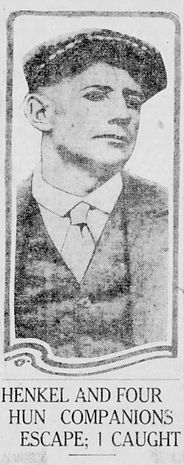
Escape #4 occurred in broad daylight during good weather. Five prisoners- Arnold Henkel, William Wegner, Jacob C. F. Bruer (Brewer), Richard Luders, and Robert Beese- did not answer for roll call at 5:15pm on that Tuesday afternoon. Capt. Yost, Adjutant of the War Prison Barracks, told the news reporter that a civilian between the post and the city had reported seeing four men making their way in that direction. Supposedly they had dug under the stockade fence. As with previous escapes, a $50 per escapee reward was offered. The "delivery" (prison break) was thought to have occurred around 3pm.
That evening, prisoner Richard Luders was the first to be captured in the area of what would today be considered East Ridge. Local resident E. A Wheatley, advertising manager for Chattanooga Medicine, heard that one of the prisoners might be in the vicinity of his land. He sent his chauffeur William Buttner in his car to scout the area down Ringgold Road. The article states Buttner took with him "a negro" named Tom Ward. Buttner and Ward were probably rambling along at a slow speed on the dusty Ringgold Road, looking out over fields and patches of woods as if they were out searching the neighborhood for their lost dog. Suddenly, they saw a man in one of the fields. They stopped and asked him if he wanted a ride. The man said yes and climbed into their automobile machine.
As the article goes, they started into town, and when their passenger began to show signs of "wanting to get away, Ward drew a .44 Savage and calmed him with it." And continuing, "The negro still had the gun on the German when the trio showed up at the police station." Luders admitted to his captors that he was a citizen of Germany and was one of the escaped prisoners from the war prison. However, when he was being interrogated at the police station, Luders claimed he had escaped alone. He said he cut through the wire without any other fugitives. His personal property at the police station consisted of a watch, $4 in change, and three little keys. Since prisoners were not allowed to keep money in their possession in the prison camp, there was speculation that he had encountered someone sympathetic to his plight. The reporter described Luders as a "dull, illiterate looking fellow, slender, brown convex face and long upper lip. He speaks English thickly, but correctly."

Photograph of F. Brewer (Bruer), courtesy of the National Archives

The article states that a man named Dave Lomenick, an employee of the Chattanooga Bakery (home of the Moon Pie), saw a strange man this same morning about a mile and a half east of the ridge. This may have been the report that got the attention of Mr. Wheatley, who then sent Mr. Buttner and Mr. Ward scouting for this stranger. (The Lomenick farmlands were large tracts "east of the ridge" that make up a large part of the present-day City of East Ridge, TN. The Lomenick Cemetery claims to be oldest continuously operated cemetery in Hamilton County. Their cemetery is about a mile and a half east of the ridge.) Mr. Lomenick described the stranger as wearing an army shirt, blue pants, a cap, and overalls under his arms. He also said he appeared wet, as if he had been wading through a creek. At the police station, Luders was noted as wearing a wool cap, prison overalls, and old pair of shoes, and an army shirt. Luders was eventually returned to the War Prison Barracks at Fort Oglethorpe. May 21, 1918, was the day that the citizens of "East Ridge" caught an escaped German prisoner.


The second prisoner- Robert Beese- was captured on May 22. He had covered an astonishing 95 miles in one day to Oakdale, TN, a small town 23 miles west of Oak Ridge, TN. Beese had apparently jumped a freight train out of Chattanooga, but had fallen asleep enroute. While making his inspection rounds in Oakdale, train conductor B. T Cahoon, a resident of Chattanooga, discovered the sleeping interloper on a railcar and woke him up at gunpoint. Mr. Cahoon was aware of the escape through the news. After questioning Beese and hearing his foreign accent, became convinced this was possibly an escapee. Cahoon escorted him to the local YMCA, where Beese was compared to the notice that was posted there about the escape and descriptions of the prisoners. Cahoon then turned Beese over to W. Y. Denton, special agent for the CNO & TP Railway, who took Beese into custody and returned him to Fort Oglethorpe.
Over the next week, there were reports that Henkel had been spotted. Once in Calhoun, in Cartersville, and finally on Sand Mountain. None ever materialized into a capture. An update in the June 11 edition of the Daily Times confirmed that three of the men- Henkel, Bruer (Brewer), and Wegner remained at large. This author can find no evidence in newspapers during the rest of the war that these three were ever caught.
An opinion article in the May 25 edition of the Chattanooga News accused some of the guards at the War Prison Barracks No. 2 at Fort Oglethorpe of being sympathizers of the Germans and allowed the escapes to happen. The nature of the escape during broad daylight does seem suspicious.
The Chattanooga News, May 25, 1918
The news reporting around escape #4 suffers from several inconsistencies. First, the Chattanooga Daily Times stated four prisoners escaped, but the Chattanooga News claimed five prisoners escaped. This may be due to the Chattanooga News being an evening publication, so the information about the fifth prisoner may not have been known in the morning edition of the Daily Times.
Secondly, the Daily Times' description of Henkel's capture in escape #2 the previous August is wildly fantastic versus what was reported at that time. For example, the account at that time said that Henkel grew nervous that Farmer Turner was on to his identity and broke into a run toward the door, when Turner fired a pistol and struck Henkel in the arm. Nine months later the reporter is giving the backstory on Henkel's previous escape saying that Henkel picked up the farmer's little daughter and used her as a body shield, yet Turner managed to take aim and hit Henkel in the arm with buckshot. It seems highly unlikely that Mr. Turner could selectively place a spray of shotgun pellets around his daughter and hit Henkel in the arm. This author believes the backstory was more accurately depicted at the time than in the recap in this present article.