
Escape #8: August 10, 1919

Chattanooga Daily Times
See also The Chattanooga News
August 11, 1919, which reports incorrectly the reward as $500
Escape #8 occurred before Seibert had been caught. Perhaps his perceived success had emboldened other prisoners to try their luck. This "delivery" was carried out by Robert Beese and Richard Luders. The reader may recall that both these men were involved in escape #4, where Beese was captured in Oakdale, TN, after hopping a train overnight. Luders was captured by several citizens of "East Ridge," just two or three miles north of the prison camp. That escape occurred during broad daylight with three other prisoners, whereas this time Beese and Luders acted alone. Like escape #3, Beese and Luders took advantage of a heavy thunderstorm that was rolling through the night. On the way over the wire fence, as lightning was flashing all around, Luders was shot and captured. Beese got away.
What happens after this is baffling. According to newspaper research, Beese is captured twice, five months apart. Luders later would be reported to have died, but the War Prison Barracks never released such information, and they always previously released the names of prisoners killed by guards and described their funeral arrangements.
Beese's first capture was in Rome, Georgia, as reported in the September 14, 1919, edition of the Chattanooga Daily Times. Apparently, Beese was going from door-to-door begging for food when people began to suspect he might be the escapee from the news. As the curious citizens began to follow him, Beese became paranoid and broke into a run. The townspeople ran after him, chasing him up Broad Street where he was cut off by Patrolman Wilson, who nabbed him and took him to the station. Patrolman Wilson was reported to have been given the $50 reward offered by Col. Penrose's office.
One point that makes this story suspect is that a reward offer would never be given to, or taken by, a police officer. Capturing criminals is what they do, they are already paid to do this.
Five months later, on February 26, 1920, Beese is reported to have been captured again in New Orleans. This time he aroused suspicion from patrol officers with his "nervousness."
The Rome Capture

Chattanooga Daily Times
The New Orleans Capture

Chattanooga Daily Times
Which story about Beese's capture is correct, the Rome or New Orleans story?
First, we need to ask, did Beese escape a third time, after his capture at Rome?
There is no evidence of this. Col. Penrose, to the best of this author's knowledge, never withheld escape information from the public. In fact, he counted on his press releases to enlist more eyes around the region to help find the missing men. As we have seen, this was a successful tactic. It is unlikely that Penrose would have concealed an escape. By all accounts, Penrose was an honorable officer and remained 100% accountable to the War Department in Washington throughout his tenure at War Prison Barracks No. 2. This means that one of these capture reports cannot be correct.
Which article more strongly demonstrates that Beese's identity was established?
The Rome story says, "the captured man was found to tally exactly" with the description of Beese, "even to his decidedly English face and pronounced accent."
The New Orleans story says that Beese's identity was confirmed by Roy Holden, who had been a "military intelligence" agent during the war. February 1920 was after the war and apparently Holden was now an employee of the Travelers Insurance Company, presumably at their New Orleans office. But how was Holden able to recognize Beese as the escaped German intern?
For this, we need to back up to December 8, 1917, in Torrington, CT, about 30 miles west of Hartford. We also need to weave in information from a second news story that appeared in the Hartford Courant after his arrest in New Orleans. The two columns are a little over two years apart but together they paint a clearer picture of Robert Beese's identity.
Beese, like all other German Nationals living and working in the US, was required to register as an alien enemy. Sometime in 1917, Beese registered in Brooklyn, NY, which meant that he was required to remain in that area and travel was not permitted unless granted. By December that year he was living and working in food service in Torrington, CT. We do not know what drew the attention of authorities to Beese in Torrington, but he was arrested. The news states he was "traveling without a permit," but an index card in the National Archives states that he was "found in a restricted area."
The March 2, 1920, Hartford Courant article tells us that Holden was sent to Torrington when Beese was arrested, and that Beese was transferred from Torrington to the Hartford County jail. Thus, we may assume that Holden conducted the prisoner transfer to Hartford on or shortly after December 8, 1917. Holden's name pops up again about two weeks later in the Hartford Courant, where he supported a US Marshal's team in transferring eighteen US soldiers who had gone AWOL (absent without leave) back to Camp Ayer, Massachusetts. The article says Holden is connected with the naval department. This demonstrates that Holden was skilled in prisoner transfer and most likely did spend time with Beese.
At the Hartford jail, it was decided that Beese was to spend the rest of the war at War Prison Barracks No. 2, Fort Oglethorpe. It is plausible that Holden accompanied Beese on the long journey south to Georgia, but we have no proof of that. Even so, the purpose of this discussion has been to show that Holden spent more time with Beese than did Patrolman Wilson or anyone else in the Rome police department, and was, therefore, a more reliable source of Beese's identity than anyone in Rome. Thus, we can say the Rome capture story is more likely false and the New Orleans capture story is more likely true.
This still leaves us with some questions that we cannot answer at this time:
-
How did Holden end up in New Orleans to perform the identification of Beese? Did Travelers Insurance transfer him south after the war? Did Holden know someone at the New Orleans Police Department that told him about an unidentified German prisoner? It just seems tremendously convenient that Holden appeared on the scene.
-
How did the story about the Rome capture come about? Was this a publicity stunt fabricated by the city? Did the Justice Department fabricate the story for the purpose of flushing out some other subversive operatives?
-
How did the newspaper reporters miss these conflicting reports? Were reporters and their readers suffering from "media fatigue" around the wartime topic of alien enemies. The war had been officially over for eight months at the time of Beese's capture in New Orleans. It is possible that few really cared anymore about following up to get the truth at the heart of stories. The capture stories, whether Rome or New Orleans, were becoming more and more "buried" in the papers on back pages.
-
Did Beese's companion Richard Luders die or not? There was never any official report issued by Col. Penrose's office to this effect. A search of the National Cemetary in Chattanooga may be in order.
This author is typically not conspiracy-minded, but this discrepancy between the Rome and New Orleans captures seems to invite the researcher to dig deeper into the story. However, for the purposes of documenting the escapes from Fort Oglethorpe's War Prison Barracks No. 2, this completes escape #8.

Hartford Courant
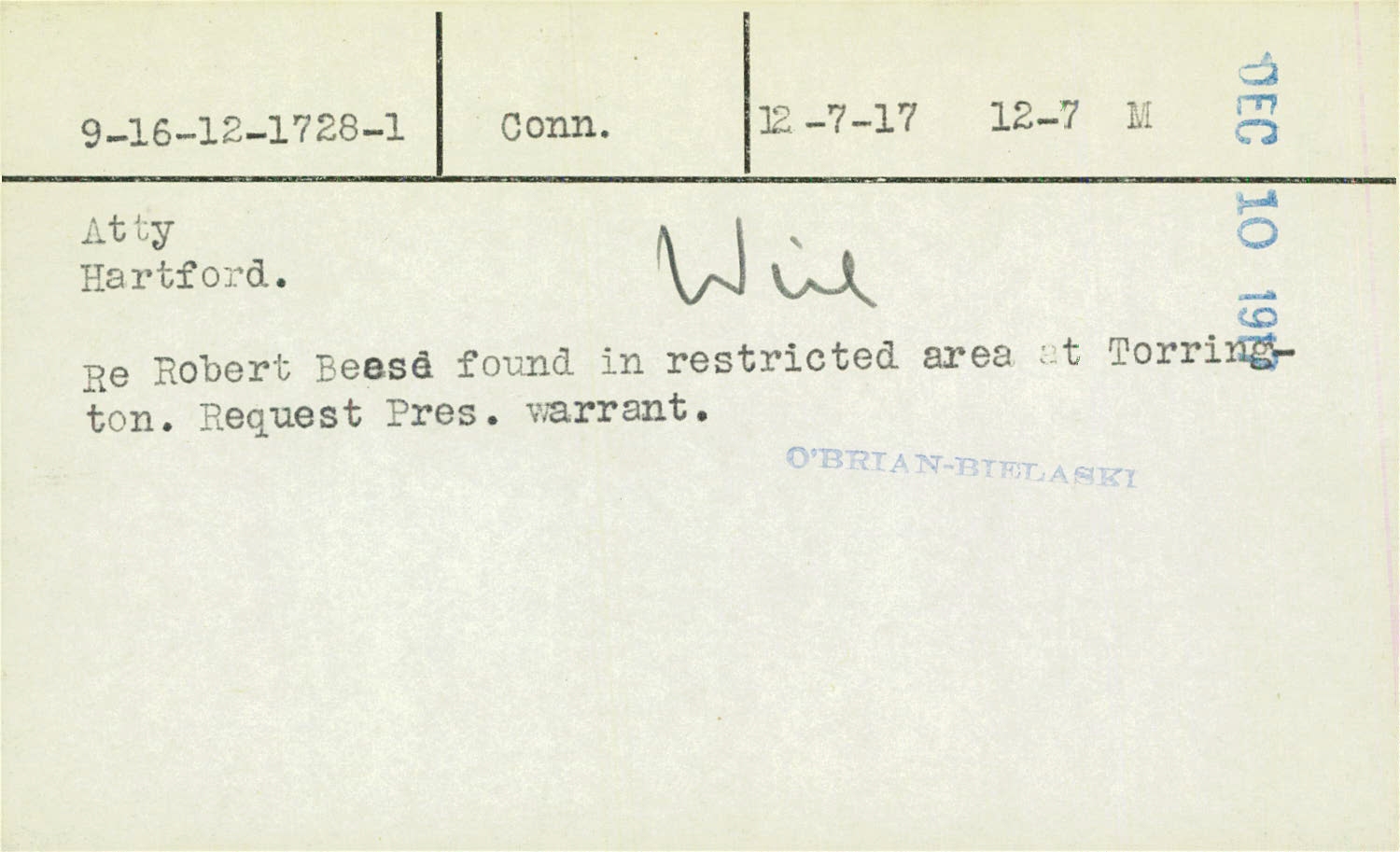
Index card at the National Archives referencing the warrant for Beese's arrest. (The author has requested the report from the National Archives and will post it when received.)